 Shipped by Prompt
The short answer
| Your app | Where it should live | Why |
|---|---|---|
| A prototype only you and a few testers open | The builder's own hosting (lovable.app, bolt.host) | Free, one click, nothing to set up |
| A real app on your own domain, frontend only or frontend + Supabase | Netlify, deployed from GitHub | Free plan covers custom domains and HTTPS; every change gets a preview link |
| A v0 project you will sell or run as a business | Vercel Pro, or Netlify | Vercel's free Hobby plan is for non-commercial use only |
| An app that needs a server running all day (websockets, long jobs) | A backend host next to your frontend host | Static hosts like Netlify run short functions, not always-on servers |
If you are still changing the app every hour in the builder and nobody depends on it yet, stay where you are. The rest of this guide is for the moment the app needs a real address.
What "hosting" means for an app built with AI
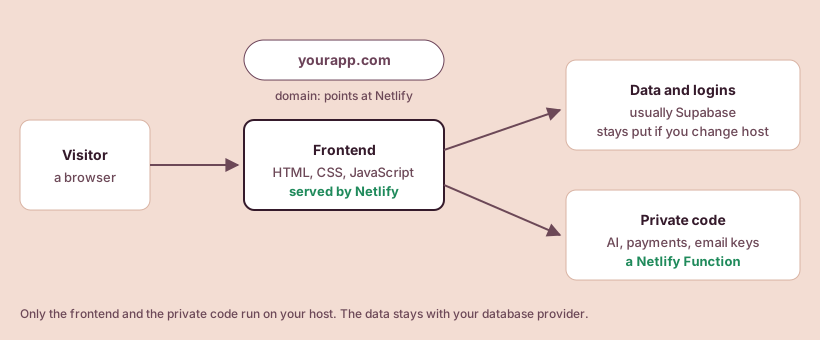
An AI-built app is usually four separate things, and only one of them is the part people call hosting:
- The frontend. The screens your visitors see. Lovable and Bolt generate a React app built with Vite; v0 generates Next.js. After a build, a Vite frontend is a folder of HTML, CSS and JavaScript files.
- The backend. Code that must stay private: payments, calls to an AI model with your API key, sending email. Many AI-built apps have none, or keep it inside Supabase.
- The database and logins. Usually Supabase. It is hosted by Supabase whatever you pick for the frontend, so moving the frontend does not move your data.
- The domain. The name people type. You rent it from a registrar and point it at whoever serves the frontend.
So "where do I host this?" mostly means "who serves my frontend files, and who runs the few bits of private code?" That is a much smaller decision than it sounds, and you can change it later without losing users or data.
Option 1: keep the builder's hosting
Lovable publishes any project to a lovable.app address for free on every plan, with HTTPS included. Bolt does the same on a free bolt.host address, and its free hosting tier allows up to 10 GB of bandwidth and 333,333 requests a month.
The catch is the domain. Both builders put custom domains behind a paid plan: Lovable from Pro at $25 a month, Bolt from Pro at $25 a month (prices checked 31 October 2026). If you downgrade, Bolt's docs say custom domains are disabled. You are paying a builder subscription partly to keep a website online.
That is fine while you are still building every day. It gets awkward when the app is done and you would like to stop paying for AI credits you no longer use.
Option 2: Netlify
Netlify serves the built frontend from a GitHub repository. You connect the repo once; every time the builder pushes a change to GitHub, Netlify builds and publishes it.
Who Netlify fits
- Apps from Lovable or Bolt (Vite + React), with or without Supabase.
- People who want their own domain without paying for a builder plan. Custom domains and HTTPS are included on Netlify's Free plan.
- Anyone who wants to check a change before it goes live. Netlify gives each pull request its own preview URL.
- Apps that need a contact form or waitlist. Netlify Forms works without a backend, and submissions are free and unlimited on the current plans.
- Apps that call an AI model or payment API and need somewhere private to keep the key. Netlify Functions run that code on the server side.
Who should pick something else
- If you never want to see GitHub, keep the builder's hosting. Netlify's normal path starts from a repository.
- If your app needs an always-on server, Netlify Functions are not the right tool. Put that part on a backend host and keep only the frontend on Netlify.
- If you built in v0 and are happy on Vercel, you can stay. v0 publishes to Vercel in one click and its code is Next.js, which Vercel makes. Just check the plan: Vercel's Hobby plan is for personal, non-commercial use.
Bolt users have a shortcut: Bolt can publish a project straight to a connected Netlify account instead of Bolt hosting. The step-by-step guide covers that route and the GitHub route.
What it costs after the free plan
Netlify moved to credit-based plans. Checked on 31 October 2026:
| Plan | Price | What you get |
|---|---|---|
| Free | $0 | 300 credits a month with a hard limit, 1 team owner, 1 build at a time |
| Personal | $9 a month | More credits for one person |
| Pro | $20 a month | Unlimited members, larger credit tiers |
Credits are spent on production deploys (15 credits each), bandwidth (20 credits per GB), web requests (2 credits per 10,000) and function compute (10 credits per GB-hour). Form submissions cost nothing.
Two things matter for an AI-built app. First, every production deploy costs credits, and builders push to GitHub after every edit. Twenty deploys use 300 credits, the whole free month. Second, the free limit is hard: when the credits run out, Netlify pauses every project on the account until the next cycle and visitors see a "Site not available" page.
The fix is simple once you know it, and the free plan guide works through real examples, including how to stop every small edit from becoming a production deploy.
The database does not move
Whatever you choose for the frontend, Supabase stays where it is. Your users, rows and logins live in your Supabase project, and the new frontend talks to it with the same keys. One thing to know: Supabase pauses free projects after a week with no activity and allows two active free projects. An app that real people use daily will not hit the pause; a demo you share once a month will.
Next step
If the app is ready for its own domain, start with From Lovable, Bolt or v0 to a live Netlify URL. If it already runs on lovable.app or bolt.host and has users, read Move an app off builder hosting first, so the switch does not break anything people rely on.
Sources, checked by hand
- Lovable: Hosting2026-10-31
- Lovable: Custom domains2026-10-31
- Lovable: Subscription plans2026-10-31
- Bolt: Hosting plans2026-10-31
- Bolt: Domains2026-10-31
- Bolt: Publish to Netlify2026-10-31
- v0 FAQ2026-10-31
- Netlify pricing2026-10-31
- Netlify: Credit-based pricing plans2026-10-31
- Vercel pricing2026-10-31
- Supabase pricing2026-10-31